
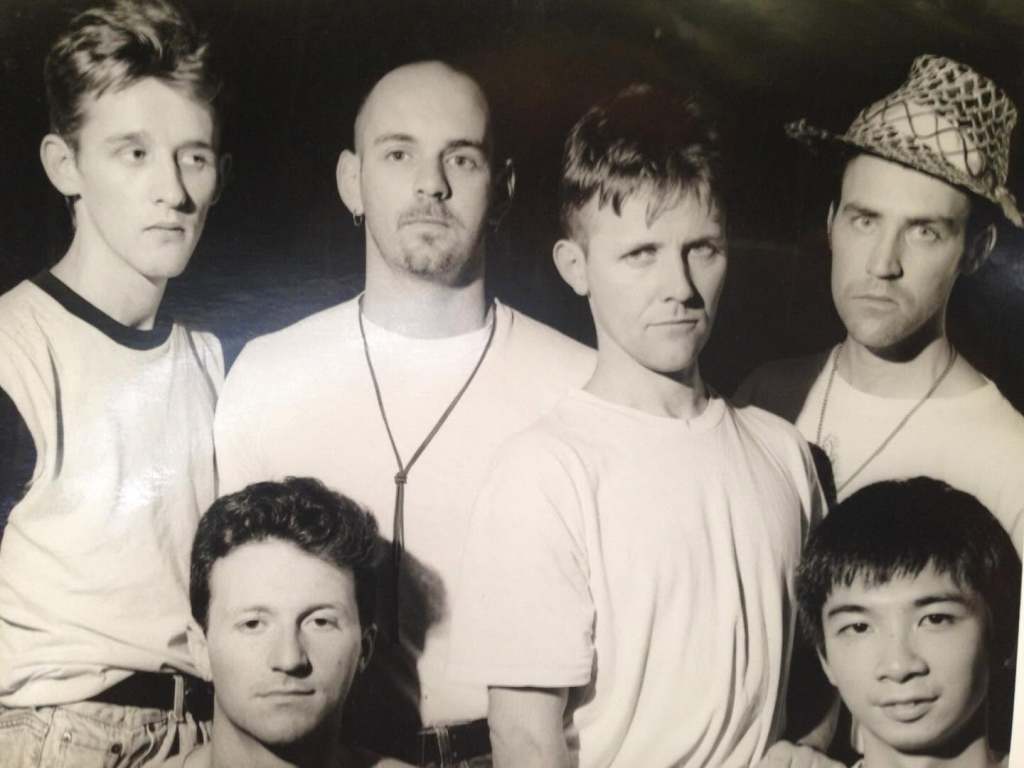
Stephen Allkins (aka Love Tattoo) is an Australian DJ and producer.
He is a pioneer of Sydney’s gay club and dance party scene, moving up from playing small inner city clubs and pubs in the early to mid 80s, to regularly playing the Gay and Lesbian Mardi Gras and the huge dance parties at the Hordern Pavilion later in the 80s and into the 90s.
As an ARIA nominated dance music producer, under his artist alias Love Tattoo, Stephen is best known for his stonking house tracks “Drop Some Drums” (2000) and “Bass Has Got Me Movin’” (2001).
Stephen and Robert worked on remixes and edits together, including official releases, under their “A & R” moniker.
Stephen and Robert were, in Stephen’s words, “soul mates”.
I interviewed Stephen via video call on 1 October 2026.
Stephen Allkins: I’ll tell you how we met. So, I’d been DJing for a few years, and I wasn’t DJing like anyone else… I’d use three copies, I would overlap… I’d do all this stuff, because I had a weird brain.
One day I was having lunch in about 1983 at a cafe, and Robert walked up to me and said, “Hi”, and introduced himself, and I said, “Hi”, and he said, “I’m a big fan, and I come to Patchs every week.”
So he’d listen to what I’d do, and he’d know what I was doing. And he’s like, “I just bought a reel to reel”, because The Latin Rascals were very big. We both loved The Latin Rascals. “I just bought a reel to reel and I’m just wondering if you’d like to come over one day and have a look at it?” and I went, “Sure!” That was it, the rest was history because I went over… we just got on like a house on fire.
So basically for nearly ten years, we would get up, go and meet at Stanley Street for coffee at one in the afternoon because we were both night workers, we’d spend twelve to fifteen hours a day together, then we’d part company at six in the morning, and then do it all again. We did this every day.
So we did an edit of Chaka Khan’s “Ain’t Nobody”. That was the first thing we ever did. It was in a way simple, but it was double the length and you’d never have known.
Because we had this thing of style… when it was hard it was hard, when it was grace it was grace, all that sort of stuff. I would go and listen to him every time he worked, and he’d come and listen to me. And so we were similar, but different, and his mixing and deejaying was like nothing I’ve ever… he was the only person that inspired me. And I inspired him.
The great thing was we’d do it with love. Because we always wanted to have fun, but do the best we could. Just as an example of Robert’s mixing genius… ‘cause you see, he was the logical one, and I was the pretty one. I was very ‘feel’ but got to do it right, and he had this almost mathematical thing… and one night he used two copies of New Order’s “Sub-culture”, the John Robie mix, and I was never crazy for it, because it was a bit thin for me. But he was playing it at the midnight shift on a Wednesday night, and I’m standing there… ‘cause I know my shit… and I didn’t know what he was doing! I mean, it was perfect, he changed the rhythm of the song! But in those days you did it live… it was only me and him doing it… and I’m like, “What the fuck are you doing?” And I got halfway through the song and I’m like, “I can’t take this anymore”, so I run up to the DJ box and I said, “What the fuck are you doing?” And he had… the second copy was a third of a beat behind… a third! Because even if I did that I would go half a beat behind, one beat behind, two beats… a third of a fucking beat, and then he was panning it across and it was perfect. It sounded like a rhythm… it wasn’t jarring and it wasn’t… And I’m like, “You’re fucked! You’re a fuckin’ fucker!”
Another thing he did there was a song called “Save Your Love (For #1)” by Rene and Angela, and in the middle she hits a long high note, and he had three copies of that and he put it four bars behind, I think. So three copies, four bars behind… so she starts hitting the note, and in the middle he cut into the other one, and so the note went for, like, twenty seconds. But you couldn’t hear it. Everything had to be perfect with us.
So that’s just two examples of the mixing, and I was so honoured that I inspired him to do that. I mean… because I was fucking around, not knowing.
And then (tape) editing… he was so precise, he could do sixteen edits in four beats. But also, it was a musical thing. And the stuff he would do…
I’ll never forget we used to go to a record store called Floppy Disk, which was the best record store, and Joe and Alan who ran it were both musicians, and they loved us and we loved them. And Alan had this weird… it was like the size of a matchbox, and it was a 60’s delay, and he gave it to Robert. And Robert used it in a track. It looked like it was put together with a rubber band.
We’d go to New York maybe once a year, because he kept trying to break into the production and all of that stuff, and he just couldn’t get it. While he was there, because he wanted to get his edits played as well, he did a re-edit of Janet Jackson’s “When I Think Of You”, the album version, ‘cause that was the best one. You know, you edit the best version. I could go on for hours with what he did to that song. One of the things he did with that elastic band delay, it sounded so pristine and amazing, and he had nothing to hold it together, he had to slide everything in, if he was doing an effect or whatever.
That’s one of my traits, I hear pushing, and pulling, and something, and something. Robert was also like that. We just wanted to do the best.
His thing was, being a DJ also, you’ve got to mix over it. Most people that edited, including The Latin Rascals, you couldn’t mix over their stuff because it was edited, but not cleanly. Being real DJs, we’d hear it.
And Lady Marmalade, that’s the one. Lady Marmalade is the one. 1986, I think it was, we were still in Latin Rascals territory, samplers were just about to start, and out of the blue he goes, “Oh, I’m doing this edit of Lady Marmalade”. And I went, “Oh, ok, sure!” And he started it, and I heard… I had never heard anything like that in my life. Because this was pre the next step. This was when everything was chopped, and…
So he’d started, and he had a one beat sample, like this going, “Hey – hey hey – hey”. And this is all edited, got a different sample of the very first note of the grindy organ. Now, he had to edit those live, and then mix them together. So he had to edit both perfectly or they wouldn’t have kept time.
I’ve still got, I mean I’ve got all the edits, even if on tape, and I know exactly what he did every fucking edit!
And then the first sampler came out. I remember it was five thousand bucks, it was a big box, and Robert bought it the day it came out, took it out of the box and just sat it on a table and just started going, “jiggy jiggy jiggy jiggy”. See, I’m the pretty one, I had no idea what was going on, but Robert straight away was mucking around with it and knowing… and this was the first sampler, so he had no reference.
And from there it just went equipment, equipment, equipment, equipment, and he started the production stuff. So slowly, but surely, in the end he was doing so much production that the Djing and the editing went by the way. But it all became part of his production style.
I don’t know if people remember, but back then, if you were a real producer, which all the dance people were, you would build up a kick… you’d have three kicks and put them together to make this warm, fuzzy, thick, thin, whatever you wanted like… they never sounded the same. It wasn’t just turn it on. And Robert was the queen of all that. I mean, simple things like that, he’d spend a day getting a kick together.
You’d know it was a Robert production. Kathy (Naunton) was an engineer, but Robert produced the albums for Beatfish and Boxcar, and whoever else. And you know, in a way, he created the Severed Heads sound. Because I know what they were initially, it was all, you know it was dirgy, but that was the anti-everything movement. But then Andrew (Penhallow) handed Robert… “Do this”, and that, to me, created the Severed Heads sound because “Dead Eyes Opened”… and all the others, they’re all Robert’s productions, almost Robert’s tracks. But that’s not taking away from anyone.
That’s what a producer did with a good track in the old days, and Robert was the queen of that because he looked at the Arthur Bakers and the David Morales’, and where it was mastered you know… Herb Powers. We’d buy records and, “Oh look it’s mastered here…”
And he’d influence me all the time, and it’s amazing because we both loved to impress each other but with love. I’ll never forget one night I was playing at Jamison St at Berlin, and I used to do this mix of Shannon’s “Give Me Tonight” with a percussive break that goes for three or four minutes, ‘cause I’d put hard electro over percussion, or mix things up, that was what I did. And I’m just doing this mix one night, and this song was a huge hit, and Robert ran to the box and he’s like, “What are you doing?” And I said, “I’m just putting this over this” And he says,”Oh my god, we’ve got to do an edit! That’s so good!”
We had such a love thing going on, and such a respect. We had the same sense of humour.
And you know the production speaks for itself… and all of that, his mixing, his editing, and even the way I’d watch him progress… ‘Cause the Lady Marmalade was like nothing I’d… there wasn’t even a reference… I’m like, “What is that?” I love when you go to hear something five times before you can even grasp what you’re hearing. You know, he’d get all the smooth and the clean and the professional, but there was always thinking ahead.
Also his taste was… you’d hear gospel house, and you’d hear Boxcar, and you’d hear… like me, we just bounced off each other. We were like two sides of a coin. He put me onto Ministry! You see he had more of that darker side, with the light, and I was more percussive, and very black culture.
I mean, the mixes we’d do live… we’d just inspire each other. There was never jealousy, there was never whatever. We never wanted to do each other’s mixes. It would just inspire us to do something better.
He was so brilliant, and funny! With a heart of gold, such a lovely human being. Generous, he’d talk to everyone. He just had it all really. Gone way too fucking early.
[On Robert and Stephen’s remix of The Venetians’ “So Much For Love”] Yeah, it was official. It went to number one. It was released as a twelve because the song did so well, and then when it came out in the States I think it was the Steve Thompson remix on the A-side [Editor’s note: the A-side “Rock Mix” was actually produced by Mark Opitz, and “rearranged” by David Skeet and Tim Powles] and we were on the B-side.
And then he did The Rockmelons.
After doing all the production of dB Love, and all of that, he decided finally he was going to make his own album. As Robert, and ‘Blue’, which was the first track… he learnt to program keyboards, he did everything, the piano and keyboard solos… he did it all. And then he passed away.
And this track (“Blue”) is gorgeous. The production on it! Try and think of anything it reminds you of, because it’s when house is big for the first time, also it’s one hundred and twelve (beats per minute) and it’s housey, or you know like deep house, but still it’s Robert. And when you hear all of the instruments, the piano and all of that, it’s Robert.
I’ll never forget, because I didn’t play it until after he passed… and I used to work at Sublime in Pitt Street which had the best sound system, and one night I started my set at ten o’clock with “Blue”. The very first thing that happens is this “whoosh” sound… I pressed play and the whole room shook. Just with that sound. And then you go, “That’s Robert”. Understated, and over the top. I’ll never forget that moment.


Leave a Reply